
Voice level and position
Enable each voice independently. Set its level from -24 to 0 dB and pan it anywhere from left to right.
Free trial available
Give one part more sides. Place four detuned, delayed voices around the original for a wider vocal, a thicker guitar or a moving synth.
€4.99one-time
Try free for 30 daysOr get all eighteen plugins with Spark Complete for €27.99. Your free trial starts on activation. No card, no automatic charge.
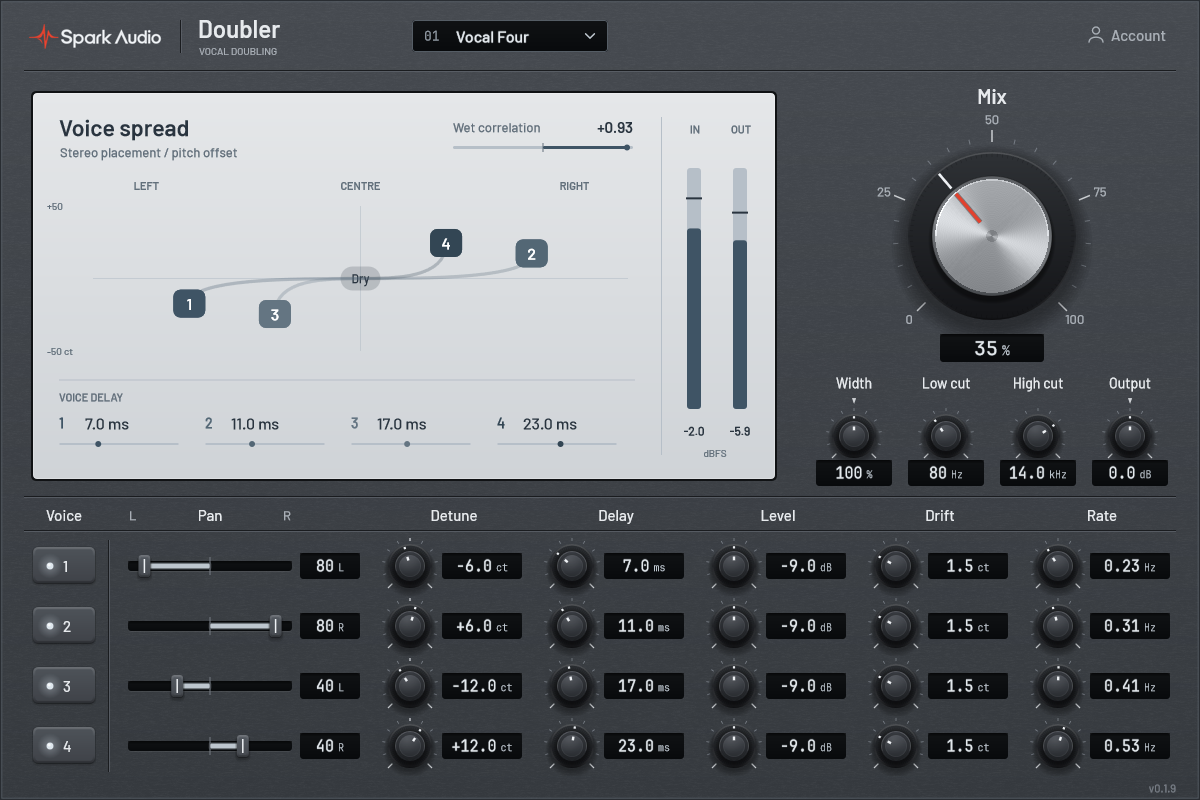
Small differences in pitch and timing turn the processed voices into a layer you can place, blend and move.
Keep the original vocal in front and bring two quieter voices out to the sides. Add a little positive detune on one side and negative detune on the other.
Start with two voices
Raise Blend slowly. A subtle layer can make space around the lead without turning every syllable into an obvious echo.
Give a guitar, backing vocal or synth four different positions in the stereo field. Offset their delays and levels so each voice has its own place.
Keep the arrangement clear
Use the wet low cut to leave room for the bass and kick. Bring down High Cut when the doubled layer competes with the lead.
Drift changes each voice’s pitch over time. Different depths and rates can make a sustained part feel less static or push it toward a chorus texture.
Choose the motion
Keep drift restrained for a stable center, or turn it up when movement is part of the sound.
Shape each voice separately, then set the blend and overall width.
Enable each voice independently. Set its level from -24 to 0 dB and pan it anywhere from left to right.
Shift each voice by up to 50 cents in either direction. Small opposing shifts create separation; larger values make the effect more pronounced.
Add 0 to 100 ms per voice to separate the doubles in time. This is added to the microshift engine’s own short wet delay.
Set each voice’s pitch movement from 0 to 20 cents and its rate from 0.05 to 2 Hz. Different rates keep the voices from moving together.
Set the balance between the original signal and doubled voices with Blend. Width ranges from a centered wet image at 0% to expanded stereo at 150%.
Filter the wet voices with Low Cut from 20 to 1000 Hz and High Cut from 2 to 20 kHz. Adjust the final output from -18 to +6 dB.
Listen to how the layer sits with the original, not just how wide it sounds on its own.
An original Spark Audio microshift engine with four voices, for mono and stereo tracks.
Go to supportStart a 30-day Doubler trial. No card required.
Start free trial